Posts

Showing posts with the label lithium-ion battery manufactures Germany

Li-Ion Battery Businesses in Germany-Kingbo Power Technology

Image
Lithium-ion battery  is a type of rechargeable battery which can be formed into many shapes and sizes for all applications. Lithium-ion battery has higher energy density, low self-discharge and capacity than other rechargeable batteries which makes them ideal. Lithium technologies have become popular and valuable in powering electronic like laptops and cell phones. Now we will just take a look at one of the interesting E-Mobility applications of Lithium-ion battery          >> Have u heard about self-balancing Unicycle? An  electric unicycle  is a self-balancing personal transporter with a single wheel. The rider controls the speed by leaning forwards or backwards, and steers by twisting the unit using their feet. Lithium battery-36V is used to power up this application Lithium-Ion battery used in Unicycles An electric Unicycle        >>    It’s al...
Image
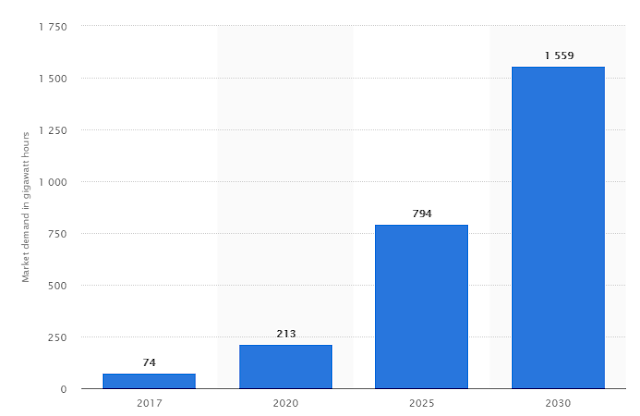
Projected market demand for lithium-ion batteries used in electric vehicles from 2017 to 2030 (in gigawatt hours) The lithium-ion battery works on ion movement between the positive and negative electrodes. In theory such a mechanism should work forever, but cycling, elevated temperature and aging decrease the performance over time. Manufacturers take a conservative approach and specify the life of Li-ion in most consumer products as being between 300 and 500 discharge/charge cycles. Evaluating battery life on counting cycles is not conclusive because a discharge may vary in depth and there are no clearly defined standards of what constitutes a cycle  in lieu of cycle count, some device manufacturers suggest battery replacement on a date stamp, but this method does not take usage into account. A battery may fail within the allotted time due to heavy use or unfavorable temperature conditions; however, most packs last considerably longer than what the stamp indicates. KI...

How do lithium-ion batteries work? - Kingbo Power Technology

Image
A lithium-ion battery consists of a negative electrode, a positive electrode, and an electrolyte. The two electrodes are separated by a porous. Each electrode consists of particles that lithium can be stored in and a porous polymer binder which holds these particles together and ensures electrical contact between the particles. Lithium-Ion battery works in similar to normal batteries. Principle is the same as exchange ions and flow of electrons.  Working There is an anode and cathode in a lithium ion battery. At present graphite (carbon) used as anode. The reason behind the use of graphite is due to its internal structure. While charging, Lithium-ion move from Lithium based cathode to anode through the electrolyte. At Anode, the Ions place themselves between two Graphite layers.  Depending on materials choices, the voltage, energy density, life, and safety of a lithium-ion battery can change dramatically.  Charging process While  Charging , th...

Benefits of LiFePO4 Batteries Over Lead Acid Batteries - Kingbo Power Technology

Image
Lithium ion batteries are quickly becoming a reasonable replacement for the old technology of Lead-Acid batteries. Lithium ion batteries are among the lightest options for applications where weight is a consideration. Lithium-Iron-Phosphate (LiFePO4) offers a better battery solution: LiFePO4 batteries  have twice the battery capacity and life span 10 times longer than lead acid batteries.  It is one of the safest type of lithium batteries as they will not overheat and will not catch on fire.  Operate with much lower resistance and recharge at a faster rate. LiFePO4 batteries is not hazardous which have no negative health hazards or environmental hazards. Due to the oxygen being bonded tightly to the molecule, there is no danger of the battery erupting into flames like there is with lithium-ion. The chemistry is so stable that LiFePO4 batteries will accept a charge from a lead-acid configured charger.  Kingbo Power Technology  ...